The Middle East and North Africa (MENA) region has spent the past five years transforming itself into one of the most strategically important esports and gaming markets in the world.
As the industry prepares to enter 2026, the trends are clearer than ever: the region is shifting from a rising challenger into an emerging global powerhouse, backed by booming revenue growth, institutional support, world-class partnerships, and a young audience driving massive demand.
In this deep dive, we explore what lies ahead for esports in the MENA region in 2026, from market predictions and publisher activity to talent acceleration, game diversification, and the new business opportunities unfolding for stakeholders across the ecosystem.
1. Market Growth: A Region Accelerating Faster Than the Global Average
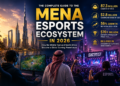
The MENA-3 region, Saudi Arabia, the UAE, and Egypt, is projected to grow its gaming market from $1.8 billion (2022) to $2.8 billion by 2026, a remarkable 56% increase. This represents a compound annual growth rate near 10%, significantly outpacing many global markets.
Several macro-factors are driving this growth:
A young, digital-native population
More than 50% of the region’s population is under 30, making it one of the youngest gaming audiences worldwide. By 2026, MENA is expected to host more than **87 million gamers**, up from 67 million in 2022.
Government innovation and investments
Saudi Arabia’s Vision 2030 continues to fuel esports infrastructure, tournaments, and game development. The UAE and Egypt are also pushing national initiatives, accelerators, and local game studios.
Growing monetization maturity
Players in the region are no longer “casual-only consumers.” They are increasingly participating in in-game economies, purchasing battle passes, and engaging in premium content. The rising ARPU (average revenue per user) confirms a shift toward deeper engagement and higher spending.
What this means for 2026
More money. More players. More investment. And more reasons for publishers, brands, and global esports IPs to permanently establish their presence in MENA.
2. Partnerships: The Engine Pushing MENA Into the Global Spotlight
2025 set the stage for a monumental year of partnerships, and 2026 is shaping up to amplify it further.
Esports Nations Cup (ENC) expands its publisher lineup
ENC recently welcomed Chess.com, MOONTON Games, and SNK to join its founding publishers. This brings a mix of strategy titles, mobile esports, and fighting-game heritage to one unified esports competition.
The combination of publishers, from EA and Ubisoft to Krafton and now SNK, positions ENC as one of the largest cross-title, multi-publisher esports programs worldwide. This is massive for 2026 because:
- It diversifies the competitive scene beyond FPS and classic PC esports.
- It attracts new audiences, from mobile gamers to fighting game communities.
- It elevates the concept of national representation in esports — turning ENC into a potential “Olympics of Gaming” for the region.
Esports World Cup Foundation (EWCF) launches the 2026 Club Partner Program
EWCF reaffirmed a $20 million commitment to support global esports clubs, accelerate their growth, and incentivize strategic expansion into the region. This initiative contributes to:
- Strengthening international participation
- Attracting legacy esports organizations to set up MENA headquarters
- Building sustainable year-round competition ecosystems
- Driving region-wide tourism, travel, and cross-border esports engagement
Corporate involvement: NVIDIA leads the tech front
NVIDIA powered the True Gaming Awards 2025 in Saudi Arabia, solidifying its position as one of the leading tech partners developing the ecosystem’s infrastructure. This signals more:
- Community-driven events
- Hardware accessibility
- Support for esports-ready venues
- Tech-backed content creation pipelines
Acceleration of local startups
Exel by Merak welcomed 19 new gaming startups into its accelerator program, reinforcing the future of locally developed games and technology. These startups cover:
- AI in game development
- Cloud gaming
- Mobile-first competitive titles
- Esports fan-engagement platforms
- Creator tools and virtual production
The growth of local studios is essential for one major reason, which is that regional content is the next frontier of gaming growth in MENA.
3. Increased Game Inclusion: A More Diverse and Accessible Esports Landscape
If 2022–2024 focused on building esports arenas, signing global publishers, and hosting mega-events, then 2026 will be the year of genre and platform expansion.
Mobile esports becomes a regional powerhouse.
MOONTON’s involvement in ENC signals a stronger competitive mobile presence:
- Mobile Legends: Bang Bang
- Free Fire
- PUBG Mobile
- Call of Duty: Mobile
Mobile channels are the fastest-growing esports avenue globally, and MENA players dominate many of these titles.
Chess.com brings tactical and educational esports.s
Chess is undergoing a global resurgence, and its competitive digital infrastructure opens opportunities such as:
- School programs
- National talent pipelines
- Hybrid esports/education collaborations
- Strategy-based tournaments appealing to new demographics
Fighting games and arcade culture rise again
With SNK joining ENC, expect:
- Regional fighting-game circuits
- Tekken, King of Fighters, and Street Fighter visibility
- Events tailored to nostalgia and arcade culture
This is especially important because fighting games attract highly skilled individuals, offering an alternative path for competitive gamers outside shooters and MOBAs.
More local games entering esports ecosystems
The accelerator-backed studios may launch culturally relevant multiplayer titles, Competitive indie games, and Esports-friendly game mechanics designed for regional adoption.
This is a turning point: long-term esports growth is not only about importing global titles, but producing regional hits with global potential.
4. Infrastructure, Talent, and Technology: The Power Behind 2026
Esports-ready venues
Saudi Arabia, UAE, and Egypt continue developing Esports-dedicated stages, Mixed-use arenas, Creator studios, and Broadcast-ready facilities, with 2026 may witness expansion into Riyadh, NEOM, Dubai, Cair, and Abu Dhabi. Plus, we will likely see smaller, community-based hubs appear across the region.
Talent Development
National leagues, academies, and club-partner programs will boost professional player development, create coaching and analyst opportunities, Support content creators building gaming-focused careers, and improve competitive standards by introducing structured pathways.
AI and Cloud Infrastructure
Startups and accelerators emphasize AI integration across Game balancing, Player performance analytics, Esports coaching tools, Anti-cheat systems, and User engagement retention.
MENA’s early adoption of emerging technologies could set it apart from other regions still navigating the transition.
5. Business Opportunities: Why 2026 Is the Moment for Investment
With growth, infrastructure, and partnerships aligned, new opportunities emerge for several sectors of the industry.
For brands and sponsors
MENA players are highly engaged and responsive. Brands can gain massive ROI through Tournament sponsorship, Creator integrations, Product placements and in-game activations, Campus-level esports programs, Hardware and tech partnerships.
For publishers
The market is primed for New IP launches, Exclusive regional servers, Localization investments, New esports circuits, Mobile-focused tournaments, and Story-driven games with local cultural elements.
For investors
The biggest opportunity lies in Local studios, Esports teams, Event-production companies, Gaming platforms, Creator economy startups, Esports venue technology, and AI-powered esports analytics tools.
For governments and tourism boards
Esports is now a part of soft power. Expect more International tournaments, Global team bootcamps, Competitions tied to tourism seasons, and Festivals merging culture, gaming, and entertainment.
2026, The Defining Year for Esports in MENA
If 2024 and 2025 were foundational years, then 2026 is the first “peak year”, when growth combines with structure, and ambition aligns with execution. The region has A booming market, A young population, Multi-publisher tournaments, Global partnerships, Local gaming studios, Government-level backing, expanding player monetization, Strong talent pathways, and growing infrastructure.
Everything points to a year where MENA no longer asks, “Can we compete globally?” Instead, it asks: “How far can we lead?”
Esports in MENA is not just expanding, it is maturing, diversifying, and positioning itself as a global force. And 2026 might be the year the rest of the world is forced to admit it.