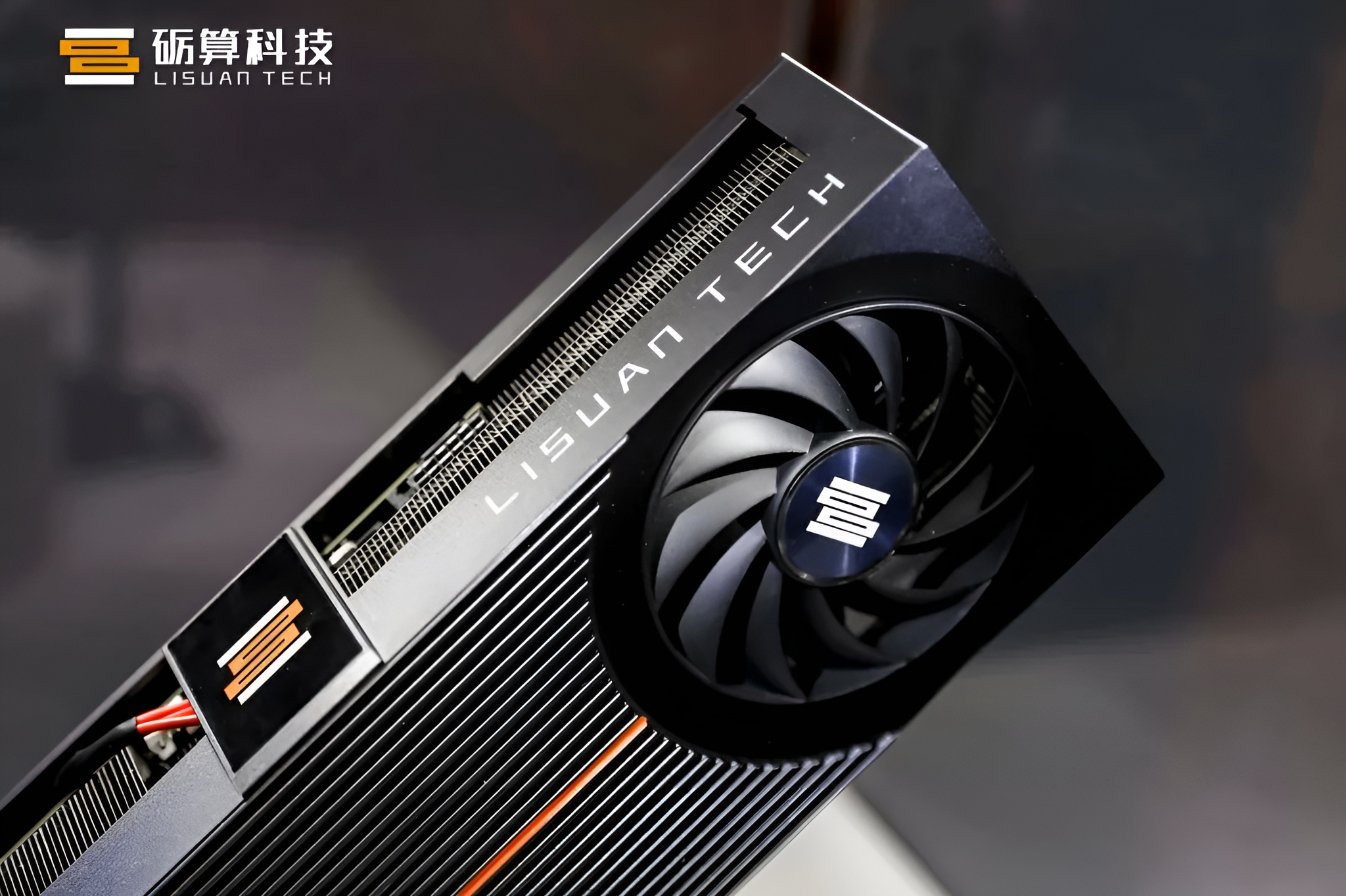
The global graphics market, long dominated by Western companies, reached a rare milestone in December 2025 as Lisuan Technology, a Shanghai-based semiconductor firm founded by former Silicon Valley engineers, officially begun shipping its first domestically developed discrete graphics processors under the G100 series.
This transition from prototype to commercial silicon signals a significant shift in China’s push for semiconductor self-reliance, offering a mid-range alternative to the NVIDIA RTX 4060 and AMD Radeon RX 7600 amidst tightening global supply-chain pressures.
Technical Specifications: The TrueGPU Architecture
Unlike previous domestic efforts that relied on licensed IP, the G100 series is powered by Lisuan’s fully proprietary TrueGPU (Tiantu) architecture. Manufactured on TSMC’s 6nm (N6) process, the architecture is built from the ground up with a self-developed instruction set.
Lisuan G100 Series vs. Industry Standards
| Feature | Lisuan 7G106 (Gaming) | Lisuan 7G105 (Enterprise) | NVIDIA RTX 4060 |
| VRAM | 12GB GDDR6 | 24GB GDDR6 (ECC) | 8GB GDDR6 |
| Bus Width | 192-bit | 192-bit | 128-bit |
| Compute Power | 24 TFLOPS (FP32) | 24 TFLOPS (FP32) | 15 TFLOPS (FP32) |
| Process Node | 6nm (TSMC N6) | 6nm (TSMC N6) | 5nm (TSMC 4N) |
| TDP / Power | ~225W (1x 8-pin) | ~225W (1x 8-pin) | 115W |
Performance Analysis: Mid-Range Ambitions
The flagship consumer model, the 7G106, targets the competitive mid-range segment. Early verified benchmarks show the G100 outperforming expectations in raw compute tasks:
-
Geekbench 6 OpenCL: The 7G106 scored approximately 111,290, placing it roughly 10% ahead of the RTX 4060 and slightly below the newly released RTX 5060.
-
Gaming Performance: In-house demonstrations showcased Black Myth: Wukong running at 4K resolution on high settings, achieving over 70 FPS.
-
Upscaling Technology: To maintain high frame rates, Lisuan introduced NSRR (Neural Super Resolution), a proprietary upscaling solution conceptually similar to NVIDIA’s DLSS or AMD’s FSR.
A World First: Discrete GPU Support for Windows on ARM
Perhaps the most strategic differentiator is Lisuan’s software focus. In late 2025, the 7G106 became the first discrete GPU in the world to publicly demonstrate working drivers for Windows on ARM (WoA).
While NVIDIA and AMD have largely limited their ARM support to Linux or data-center environments, Lisuan’s native 3D acceleration for ARM64 Windows allows it to power a new generation of efficient, ARM-based gaming desktops and workstations. In this segment, it currently has no direct competition.
The Software Hurdle: Drivers and Ecosystem
Despite the hardware’s strength, the “real test” remains driver maturity. Lisuan is building its ecosystem from scratch, supporting DirectX 12, Vulkan 1.3, and OpenGL 4.6.
Industry observers note that while the raw TFLOPS are high, gaming consistency depends on deep integration with game engines. To address this, Lisuan has also integrated INT8 support, making the G100 a dual-purpose tool for both gamers and entry-level AI inference workloads.
Why This Matters for the Global Hardware Market
For tech enthusiasts and industry players in the MENA region, the arrival of the G100 series introduces a third variable to the pricing equation. If Lisuan succeeds in scaling mass production by Q1 2026, it could:
-
Disrupt Mid-range Pricing: Force NVIDIA and AMD to reconsider the value-to-VRAM ratio in their budget lineups.
-
Provide Supply Chain Security: Offer a viable alternative in markets where Western hardware availability may fluctuate due to trade or logistical constraints.
Final Verdict: A Credible First Step
The Lisuan G100 series is not just a symbolic breakthrough; it is actual silicon in users’ hands. While it faces a steep climb to match the decades of software refinement found in the “Green” and “Red” camps, its 12GB VRAM and unique ARM support make it a serious contender for the 2026 hardware cycle.