
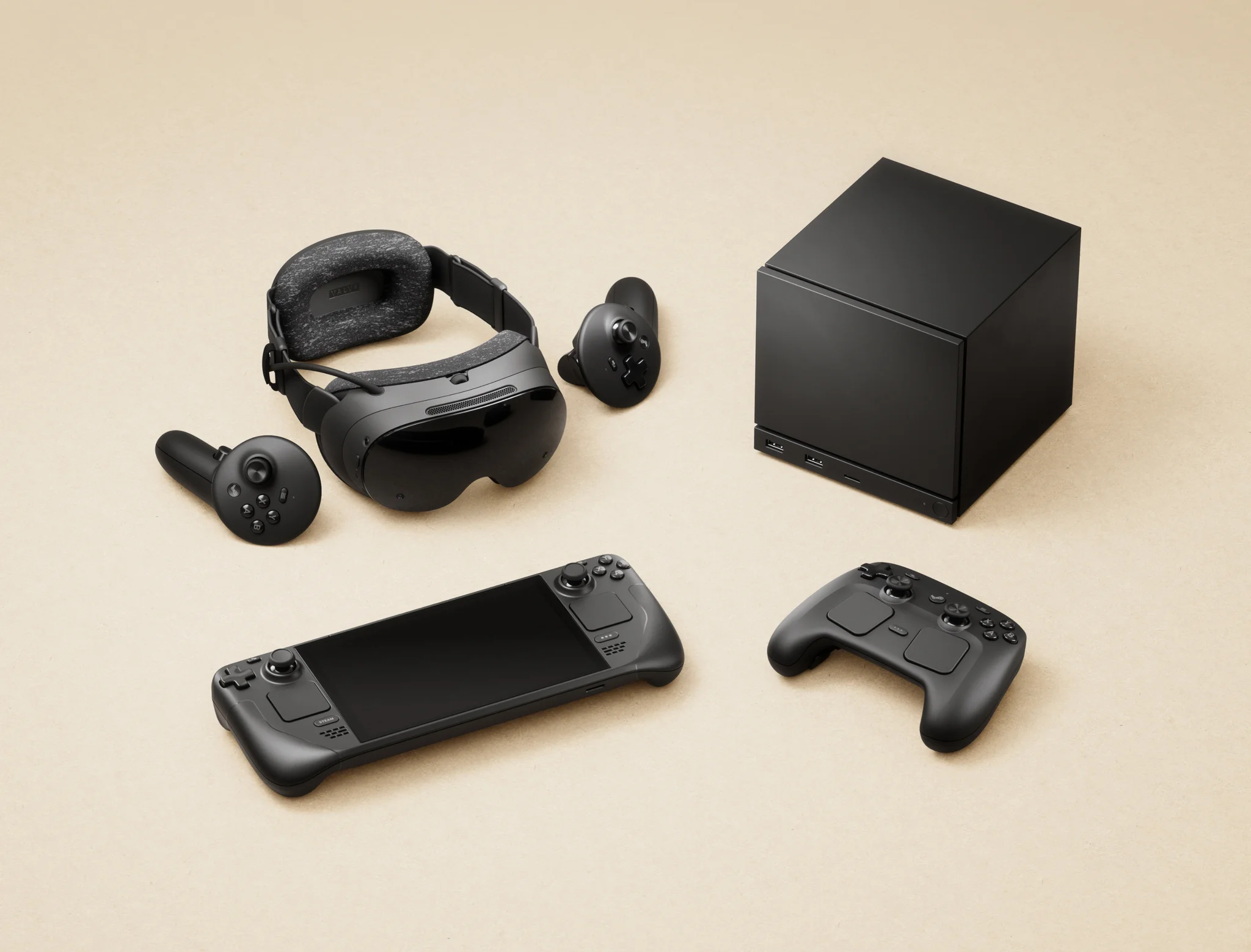
Valve didn’t just announce new hardware this week, it unveiled a full strategy shift. With the Steam Machine, Steam Frame, and a revived Steam Controller, the company is clearly preparing to expand far beyond being just the world’s largest PC gaming platform. And with more than 132 million monthly active Steam users, Valve is one of the few gaming companies capable of launching a multi-device ecosystem overnight.
The new Steam Machine might look like another compact PC, but its significance is much bigger. Powered by a custom AMD Zen 4 CPU and RDNA3 GPU that make it up to six times stronger than the Steam Deck, it’s built to push true 4K/60 performance in a living-room-friendly form.
In other words, it’s Valve’s most serious attempt yet at claiming the TV space without ever calling it a console. For millions of players already sitting on massive Steam libraries, this becomes an instant plug-and-play entry point—no ports, no subscriptions, no new ecosystem to buy into.
Alongside it comes Steam Frame, Valve’s return to VR after years of silence following the Index. But instead of competing with Meta on standalone headsets, Valve is doubling down on what it does best: PC power.
Steam Frame is a fully wireless VR device designed for high-fidelity streaming, featuring dual 2160×2160 screens, up to 144Hz refresh, dual-antenna broadcast hardware, foveated rendering for ten-times sharper image quality while streaming, and a Snapdragon 8-series chipset with up to 1TB of storage. This headset doesn’t try to replace a PC, it amplifies it and taps into a VR market that has already surpassed 30 million unit sales on the Quest alone.
Then there’s the Steam Controller, the announcement no one expected, but somehow the one that ties everything together. The original controller was strange, experimental, and divisive, but it unlocked a level of couch PC gaming that traditional controllers never could. The new model brings back dual trackpads, adds magnetic next-gen sticks, upgrades to high-definition haptics and improved gyro sensors, and integrates deeply with Steam Input and Steam Deck control schemes. With couch gaming, cloud gaming, and hybrid setups becoming more common, the controller now makes more sense than ever.
Yet even with powerful devices and a massive audience, Valve’s biggest test is distribution. The Steam Deck launch showed the world that demand exists, with millions of units sold despite long waiting lists and slow regional rollouts.
Valve says it has improved logistics since then, adding new regions, speeding up US and EU delivery, and preparing for simultaneous global launches. But releasing three major devices in the same window will push its distribution network harder than ever before.
If Valve gets the pricing right and manages to deliver these devices without the delays that defined the early Deck era, 2026 could be the moment it transforms into a full hardware ecosystem competitor.
Steam Machine anchors the living room, Steam Frame revives Valve’s VR ambitions with a smarter strategy, and the Steam Controller bridges the gap between PC flexibility and couch comfort. And unlike Sony, Nintendo, or Meta, Valve doesn’t need exclusives or subscriptions. It already owns the platform everyone uses.