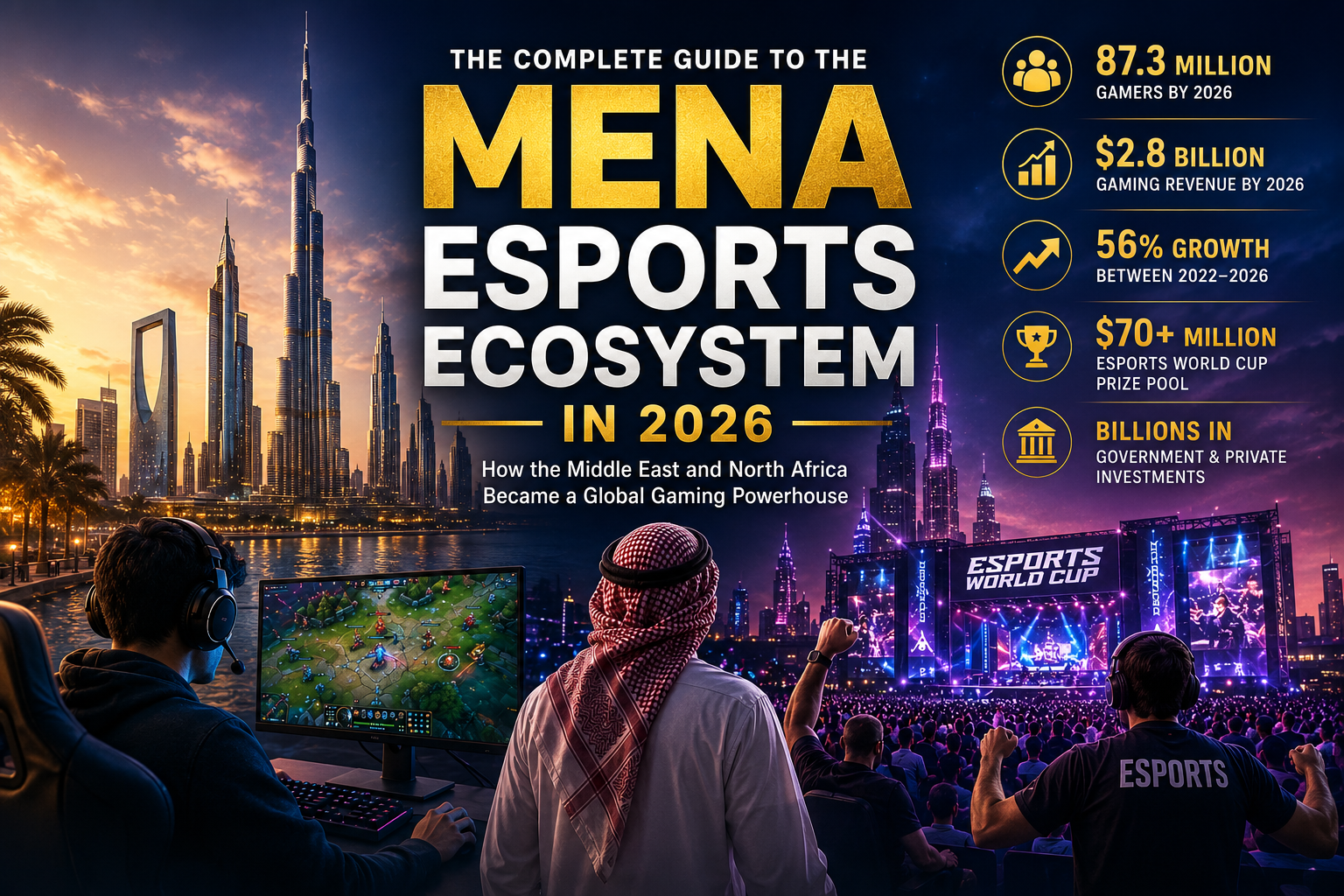
The Middle East and North Africa (MENA) has transformed from a promising gaming market into one of the world’s fastest-growing esports ecosystems. According to Niko Partners’ MENA-3 Games Market Report, the combined markets of Saudi Arabia, the United Arab Emirates and Egypt are projected to reach 87.3 million gamers and generate approximately US$2.8 billion in gaming revenue by 2026, representing 56% growth compared to 2022. This rapid expansion is being driven by a unique combination of government investment, private-sector participation, digital infrastructure, high smartphone adoption and a young population that has embraced gaming as both entertainment and a professional career.
Unlike many mature gaming markets that evolved organically over decades, MENA’s rise is being accelerated through national strategies that position gaming as an economic sector capable of creating jobs, attracting international companies and supporting innovation.
The foundation of this growth lies in the region’s demographics. MENA is home to one of the world’s youngest populations, with millions of digitally connected consumers who spend a significant portion of their leisure time gaming. Research published by Research and Markets shows that 87.2% of gamers across Saudi Arabia, the UAE and Egypt play on smartphones, making mobile gaming the dominant platform in the region.
The same report found that 71.5% of gamers actively engage with esports by watching tournaments, following professional teams or participating in competitive gaming, demonstrating that esports has become a mainstream entertainment category rather than a niche activity. Popular titles including PUBG Mobile, EA SPORTS FC, Call of Duty, Valorant and League of Legends continue to attract millions of players and viewers, encouraging publishers to increase their investments across the region.
Saudi Arabia has emerged as the driving force behind the regional ecosystem. According to the Esports World Cup Foundation, the Kingdom has approximately 23.5 million gaming enthusiasts, representing around 67% of its population, while its gaming market is valued at approximately US$1.8 billion, making it the largest gaming economy in the Arab world.
Under Vision 2030, gaming and esports have become strategic industries designed to diversify the country’s economy beyond oil. Government projections estimate that gaming could contribute around US$13.3 billion to Saudi Arabia’s GDP by 2030, while total gaming consumption is expected to reach US$6.8 billion. Rather than treating gaming solely as entertainment, Saudi Arabia has positioned it as a pillar of innovation, tourism, education, technology and economic development.
This ambition is reflected in the Kingdom’s investment strategy. Through the Public Investment Fund (PIF) and Savvy Games Group, Saudi Arabia has invested billions of dollars across the global gaming industry while simultaneously developing its domestic ecosystem. The Saudi Esports Federation has expanded grassroots competitions and professional pathways, creating one of the region’s most structured competitive environments.
According to the Federation, the Saudi eLeague features 37 clubs, more than 22,000 registered players, competitions across 18 game titles, prize pools exceeding SAR 4 million, over 33 million livestream views and more than 60 million social media impressions, illustrating how national investment is supporting both elite competition and grassroots participation.
Saudi Arabia’s international ambitions became even more evident through the launch of the Esports World Cup, which has established itself as the largest esports competition in history. According to the Esports World Cup Foundation, the tournament offers prize pools exceeding US$70 million, bringing together hundreds of clubs and thousands of players from around the world across dozens of game titles.
Beyond competition, the event has become a global meeting point for publishers, investors, esports organizations, media companies and technology firms, reinforcing Riyadh’s position as one of the industry’s most influential destinations. Saudi Arabia’s long-term partnership with the International Olympic Committee to host the inaugural Olympic Esports Games further demonstrates the country’s growing role in shaping the future of competitive gaming.
While Saudi Arabia leads the region in scale and investment, the United Arab Emirates has positioned itself as MENA’s business and innovation hub for gaming. Through the Dubai Program for Gaming 2033, Dubai aims to become one of the top 10 gaming cities in the world, create 30,000 new jobs in the gaming sector, and increase the industry’s contribution to the emirate’s economy by approximately US$1 billion.
According to the Dubai Program for Gaming 2033, the city is already home to more than 350 gaming companies, including over 260 specialized game development studios, and the ecosystem has grown by 16.6% since the initiative was launched, with more than 60 new gaming companies established during that period. Unlike many gaming initiatives focused primarily on esports events, Dubai’s strategy emphasizes game development, publishing, artificial intelligence, education, entrepreneurship and startup growth.
Abu Dhabi complements this strategy through AD Gaming, which has created a comprehensive ecosystem supporting game developers, publishers, startups and esports organizations. Through accelerator programs, training initiatives, funding opportunities and international partnerships, AD Gaming is helping attract global companies while nurturing local talent.
Combined with the UAE’s high purchasing power, estimated by industry analysis to produce one of the highest average gaming revenues per player globally, the country has become a preferred regional headquarters for publishers, developers and technology companies seeking to expand across the Middle East and North Africa.
Egypt completes the MENA-3 ecosystem by providing one of the region’s largest player communities and a rapidly expanding esports scene. With its large youth population, widespread smartphone usage and growing digital economy, Egypt has become a significant source of competitive gaming talent, particularly in mobile esports. National competitions organized by the Egyptian Esports Federation, alongside increasing participation in international tournaments, have helped strengthen the country’s position within the regional ecosystem.
While Egypt’s commercial gaming market remains smaller than Saudi Arabia’s, its scale, talent base and community engagement make it one of the most strategically important gaming markets in the Arab world, contributing to the broader growth of the regional industry.
The MENA esports ecosystem extends well beyond these three leading markets. Morocco, Jordan, Qatar, Bahrain, Kuwait, Oman, Tunisia and Algeria are all expanding their gaming sectors through national federations, grassroots competitions, educational initiatives and digital transformation strategies. At the same time, publishers including Riot Games, KRAFTON, Tencent, MOONTON, Ubisoft and Electronic Arts have significantly increased their regional presence through Arabic-language localization, dedicated tournaments, regional partnerships and long-term investments.
This combination of government support and publisher engagement is creating an interconnected ecosystem in which players, organizations, broadcasters, universities, investors and technology providers contribute to sustainable industry growth rather than isolated competitive events.
The evolution of the MENA esports ecosystem has been remarkably rapid. Two decades ago, competitive gaming in the region was largely limited to internet cafés, university tournaments and small community events. Today, the Middle East hosts the world’s largest esports tournament, attracts billions of dollars in investment and has become a strategic destination for international publishers and developers.
From Saudi Arabia’s Vision 2030 and the Esports World Cup to Dubai’s Gaming 2033 strategy and Abu Dhabi’s developer ecosystem, governments across the region are treating gaming as a long-term economic sector capable of generating innovation, employment and global influence. As infrastructure continues to improve and investment expands across both esports and game development, MENA is increasingly positioned not simply as an emerging market, but as one of the industry’s most important regions for the decade ahead.